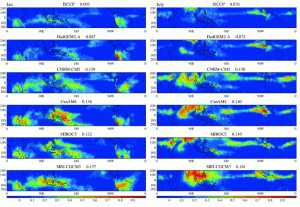
A new paper led by my colleague Yoko Tsushima has just been published online in Climate Dynamics. The paper uses a clustering method to compare the latest CMIP5 models with satellite observations of clouds – the example above shows maps of the observed and model-simulated deep convective cloud cluster in the tropics for January and July. The focus of the paper is on how well the models are able to represent the seasonal cycle of such cloud regimes and whether these comparisons can provide us with a useful metric to assess model performance. The abstract and citation are below, the full paper is here.
An extended cloud-clustering method to assess the seasonal variation of clouds is applied to five CMIP5 models. The seasonal variation of the total cloud radiative effect (CRE) is dominated by variations in the relative frequency of occurrence of the different cloud regimes. Seasonal variations of the CRE within the individual regimes contribute much less. This is the case for both observations, models and model errors. The error in the seasonal variation of cloud regimes, and its breakdown into mean amplitude and time varying components, are quantified with a new metric. The seasonal variation of the CRE of the cloud regimes is relatively well simulated by the models in the tropics, but less well in the extra-tropics. The stratocumulus regime has the largest seasonal variation of shortwave CRE in the tropics, despite having a small magnitude in the climatological mean. Most of the models capture the temporal variation of the CRE reasonably well, with the main differences between models coming from the variation in amplitude. In the extra-tropics, most models fail to correctly represent both the amplitude and time variation of the CRE of congestus, frontal and stratocumulus regimes. The annual mean climatology of the CRE and its amplitude in the seasonal variation are both underestimated for the anvil regime in the tropics, the cirrus regime and the congestus regime in the extra-tropics. The models in this study that best capture the seasonal variation of the cloud regimes tend to have higher climate sensitivities.
Tsushima, Y., M.A. Ringer, M.J. Webb, K.D. Williams, 2012, Quantitative evaluation of the seasonal variations in climate model cloud regimes, Climate Dynamics, doi: 10.1007/ s00382-012-1609-4
 Mark Ringer